 Facundo Uferer
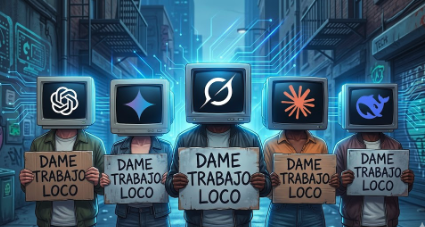
For years, the classic image of the programmer was fairly clear: someone sitting in front of a screen, writing line after line of code. But that picture is starting to get old. In recent studies about software development and the use of artificial intelligence, one idea keeps showing up with force: knowing how to code is no longer enough.
Today, the value of a developer depends less and less on writing code from scratch and more and more on understanding complex systems, working with AI tools, and making strategic decisions about how software should function.
Industry reports, academic research, and developer surveys all point in the same direction: the programmer profile is changing rapidly. And with it, the most important skills are changing too.
Thinking About the System, Not Just the Code
One of the clearest transformations is the shift in focus: from code to system.
Artificial intelligence tools can already generate functions, modules, and even complete applications in seconds. But someone still has to decide how all of that fits together.
That is where the developer’s role comes in.
Designing how a system is organized, what services exist, how they communicate with each other, how they scale as traffic grows, and how they remain maintainable over time is becoming one of the most valuable tasks in software work.
In that territory, concepts such as microservices, distributed systems, APIs, cloud architecture, scalability, and observability are becoming increasingly central in everyday practice.
In other words: less code typing, more architectural design.
Returning to the Foundations of Computer Science
Interestingly, the more code artificial intelligence can generate, the more important it becomes to understand the foundations of programming.
Algorithms, data structures, computational complexity, logic, and software design remain pillars of the craft. And they will probably become even more important.
Why? Because when an AI generates code, someone has to evaluate whether that code is correct, efficient, or simply a disaster hidden beneath an elegant surface.
Without solid foundations, that evaluation becomes almost impossible.
The New Critical Skill: Reviewing AI-Generated Code
Another major shift highlighted by recent studies is the growth of a task that used to be secondary: code review.
In AI-assisted development, programmers are spending more and more time analyzing what generative tools produce.
Detecting bugs, finding inconsistencies, validating logic, and identifying possible security issues remain deeply human responsibilities.
AI can write code. But someone still has to make sure it actually works.
Learning to Work with AI
If the programmer once had a code editor as their main tool, today the landscape is much broader.
More and more developers need to master AI-based tools and integrate them into their workflow.
That includes everything from prompt engineering to the use of coding agents, automated generation pipelines, and systems that combine multiple models.
The key is not just using AI from time to time, but incorporating it as part of the everyday development process.
Integrating AI into Applications
Beyond using artificial intelligence to write software, many developers are now also expected to integrate it into the products themselves.
That means becoming familiar with concepts such as generative models, natural language processing, model APIs, RAG systems, and multi-agent architectures.
Not every programmer will train models from scratch. But more and more of them will need to understand how those systems work and how they can be incorporated into real applications.
Software Is Infrastructure Too
Another clear trend is that modern software does not live only in code.
It lives in infrastructure.
That is why cloud knowledge, DevOps, and automation appear constantly among the most in-demand skills. Tools such as Docker, Kubernetes, CI/CD pipelines, and platforms like AWS, GCP, and Azure have become part of everyday work.
AI can help write scripts or configurations. But deciding how a system is deployed and maintained remains strategic work.
The Skills AI Does Not Replace
Perhaps one of the most interesting findings from these studies is that many of the most valuable skills are not technical.
Critical thinking, creativity, complex problem solving, communication, and collaboration appear again and again as key competencies.
That makes sense: artificial intelligence automates repetitive tasks, but it is still far from fully understanding human problems, business contexts, or strategic decisions.
That is still the developer’s territory.
The Most Important Skill: Always Learning
If there is one conclusion that runs through almost every report, it is this: in technology, knowledge ages quickly.
Very quickly.
That is why the most valuable skill of the future programmer may simply be the ability to keep learning. Adapting to new tools, experimenting with emerging technologies, and moving with agility in an environment that changes all the time.
The New Programmer Profile
In short, the most valuable developer in the age of artificial intelligence is not necessarily the one who writes the most code.
It is the one who can combine several capabilities at the same time:
- thinking in terms of complex systems
- deeply understanding how software works
- reviewing and validating AI-generated code
- using and coordinating artificial intelligence tools
- solving real problems with judgment and creativity
Ultimately, the profession is mutating.
The programmer of the future looks less and less like a simple code writer — and more and more like an architect of intelligent systems.