 Facundo Uferer
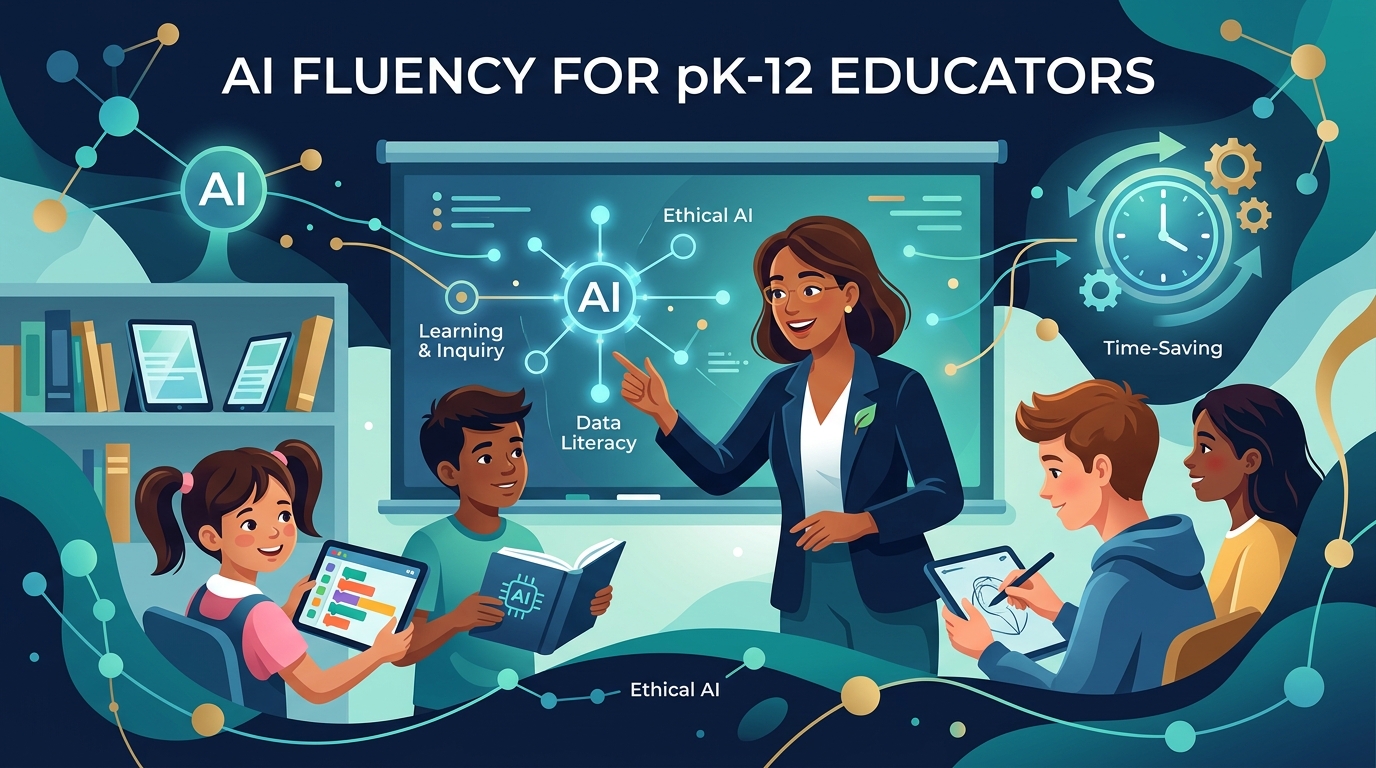
The integration of Artificial Intelligence into early childhood, primary, and secondary classrooms (pK–12) has evolved from a technological novelty into a structural pedagogical necessity. For most educators, however, the main challenge is not a lack of AI tools, but the absence of methodological frameworks to use them safely, ethically, and productively.
The AI Fluency for pK–12 Educators certification (developed by Anthropic Academy in partnership with organizations like Teach For America and the American Federation of Teachers, alongside complementary pathways from Google and MagicSchool) was built specifically to bridge this gap.
In this article, we examine the core benefits of this certification in detail: how it transforms teacher workflows by dramatically reducing lesson preparation time, how it enhances pedagogical interactions with students, and how it addresses the evaluation of AI software subscriptions for educators.
1. The Educator Challenge: Administrative Burden and Classroom Heterogeneity
In any pK–12 classroom, teachers work with students who have diverse learning speeds, specific accommodation needs (such as IEP or 504 plans), and varying levels of reading comprehension. To cater to this diversity, teachers historically spend between 10 and 15 hours per week outside the classroom on preparation tasks alone:
- Designing unit plans and lesson sequences.
- Differentiating complex texts for multiple reading levels.
- Drafting rubrics, assignments, and assessments.
- Creating individualized practice and extension materials.
AI Fluency certification addresses this challenge by training teachers to treat large language models (such as Claude, Gemini, or ChatGPT) not as replacements for human judgment, but as pedagogical thinking partners.
2. Drastic Reduction in Lesson Preparation Time
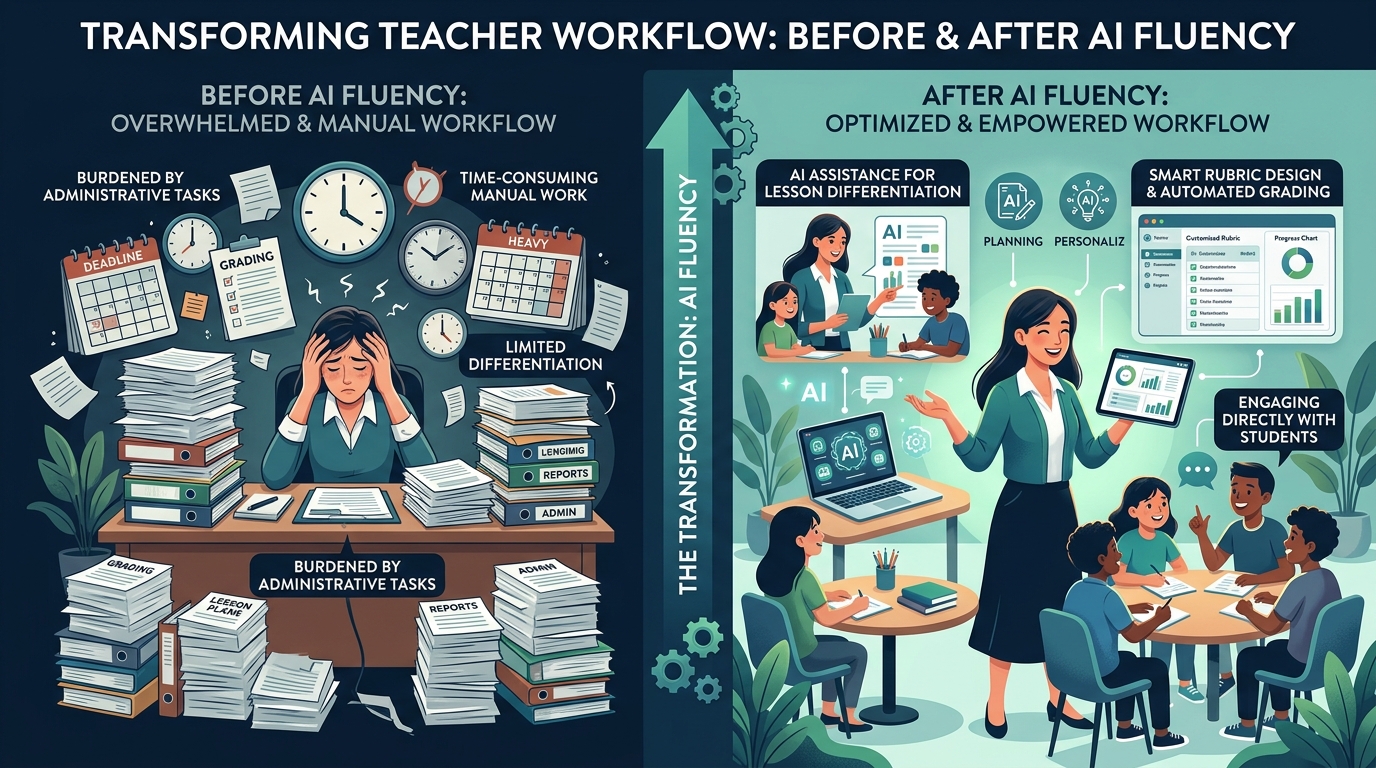
One of the most immediate and measurable impacts reported by certified educators is a 60% to 70% reduction in administrative prep time.
Key Optimization Areas
-
Rapid Content Differentiation: A teacher can input a single article or literary passage and prompt the AI to generate three versions tailored to different reading levels while maintaining core concepts and comprehension questions. Tasks that previously took two hours of manual writing can now be completed in minutes.
-
Instant Rubric and Assessment Design: Using structured prompts, AI generates detailed analytic rubrics aligned with official curriculum standards, establishing clear performance tiers (e.g., Exemplary, Proficient, Developing).
-
Special Needs Accommodations (IEP / 504): Teachers can quickly generate visual supports, simplified instructions, and step-by-step scaffolds tailored to individualized education plans.
| Pedagogical / Administrative Task | Traditional Time | Time with AI Fluency | Estimated Savings |
|---|---|---|---|
| Unit Plan Design | 4 to 6 hours | 45 minutes | ~80% |
| 3-Tier Text Differentiation | 2 to 3 hours | 15 minutes | ~90% |
| Analytic Rubric Drafting | 1.5 hours | 10 minutes | ~85% |
| Quiz & Exercise Generation | 2 hours | 20 minutes | ~80% |
3. Enhancing Classroom Pedagogy with Students
Achieving “AI fluency” goes beyond generating quick outputs; it involves mastering a methodological framework to guide students toward critical AI literacy. The certification emphasizes Anthropic’s 4D Framework:
- Delegation: Strategically choosing which tasks to delegate to AI (initial drafts, brainstorming, generating examples) and which to reserve for human cognitive effort (ethical evaluation, empathy, deep analysis).
- Description: Crafting clear, context-rich pedagogical instructions (Prompt Engineering tailored for education).
- Discernment: Critically auditing AI outputs to catch hallucinations, inaccuracies, or subtle biases before bringing materials into the classroom.
- Diligence: Ensuring strict compliance with student data privacy regulations (FERPA/COPPA) and preserving teacher accountability.
Direct Classroom Applications
- Co-Designed Socratic Tutoring: Teachers learn to prompt AI chatbots to act as interactive tutors that ask guiding questions rather than simply handing over final answers.
- Critical Thinking and Fact-Checking: Students act as “editors and auditors” of AI-generated content, developing crucial digital literacy skills for the modern era.
4. Evaluating AI Tool Subscriptions for Educators
A frequent question among educators considering certification is whether these programs bundle or require paid software subscriptions.
1. Certification Focuses on Skill-Building over Sales
Certifications like Anthropic Academy’s AI Fluency for pK–12 Educators are free professional development initiatives. They build transferable mental models and skills rather than requiring paid software subscriptions.
2. A Framework for Assessing Paid AI Subscriptions
While the course itself does not mandate a paid subscription, it provides educators and school leaders with an evaluation framework to decide which AI tools and subscriptions offer genuine ROI:
- Free Tiers vs. Paid Pro Plans (Claude Pro, ChatGPT Plus/Edu, Gemini Advanced):
- When free tiers suffice: Basic lesson outlines, brainstorming, and quick text rephrasing.
- When paid subscriptions are justified: Analyzing full textbooks or curriculum guides through expanded context windows, leveraging interactive workspace features (Artifacts), or requiring zero-downtime access during school hours.
- Vertical Educational Platforms (MagicSchool AI, Brisk, Diffit, Khanmigo):
- Training helps teachers compare general-purpose AI assistants with specialized K-12 platforms that offer pre-built, standards-aligned teaching templates.
- Institutional Privacy and Compliance:
- A vital aspect of evaluating subscriptions is ensuring that student and teacher inputs are not used to retrain public models (a standard feature of enterprise and educational tiers).
Conclusion
The AI Fluency for pK–12 Educators certification is a vital strategic investment for 21st-century teachers. Beyond saving hours of administrative work each week, it elevates instructional quality and establishes the ethical safeguards needed to prepare students for an AI-driven future.