 Facundo Uferer

Teaching in high school involves a constant structural dilemma: limited time versus classroom diversity. In a typical class of 30 students, varying learning paces, heterogeneous reading comprehension levels, and unique educational needs coexist. At the same time, administrative workload (lesson planning, guide creation, rubric development, and paper grading) consumes the hours teachers would prefer to dedicate to direct interaction and pedagogical empathy.
State-of-the-art artificial intelligence models—particularly Claude by Anthropic—offer unprecedented capabilities in processing long context, reasoning through pedagogical steps, and generating nuanced language. However, using AI in education is not as simple as prompting “create a history test for me”. That naive approach produces generic outputs, conceptual hallucinations, or activities disconnected from classroom reality.
To transform Claude into a rigorous pedagogical assistant, Anthropic proposes the 4 Ds of AI Fluency framework: Delegation, Delineation, Discernment, and Diligence.
In this detailed guide, we explore how to apply this framework across the three core phases of teaching practice: content generation, assignment design, and formative grading with feedback.
The 4 D Framework Adapted for Teachers
The four dimensions form a continuous optimization loop:
- Delegation: Which mechanical or creative tasks do I delegate to Claude? Where do I contribute indispensable human value?
- Delineation: How do I formulate the exact prompt with clear constraints, background, and expected format?
- Discernment: How do I critically audit Claude’s output before bringing it into the classroom?
- Diligence: How do I protect student privacy and ensure institutional, ethical, and curricular validity?
1. Generating Pedagogical Content and Differentiated Readings
A major challenge in high school is reading material. Textbooks are often too abstract for struggling readers or lack depth for advanced students.
Applying the 4 D Framework
- Delegation: We delegate to Claude the creation of parallel versions of a core text, adapted to different reading levels and enriched with everyday analogies.
- Delineation: We provide Claude with the main topic, key concepts that must be covered, the student age group (14–16 years old), and style guidelines.
- Discernment: The teacher reviews Claude’s proposed analogies. Are they accurate or do they induce scientific/historical misconceptions? Does the simplified version maintain conceptual integrity?
- Diligence: Confirming that concepts align with official curriculum standards and that texts are free from out-of-context cultural biases.
Practical Prompt Example for Content Generation
Copy and enter this prompt into Claude (adjusting the brackets for your subject):
Act as an instructional designer specializing in high school education.
I need you to write an explanatory text about: [Example: The Industrial Revolution and the rise of the labor movement] for students in [9th grade / 14-15 years old].

Generate TWO versions of the text:
1. Version A (Standard / Accessible Level): Use concise sentences, clear subheadings, accessible vocabulary, and an everyday analogy to explain "alienation" or "assembly line work".
2. Version B (Advanced / In-Depth Level): Include introductory academic vocabulary, historiographical reflection questions, and a short adapted primary source from the era.

Constraints:
- Maximum length: 400 words per version.
- At the end of each version, include 3 direct comprehension questions and 1 critical thinking question.
Teacher Discernment Tip: Claude excels at generating analogies (e.g., comparing an assembly line to a fast-food kitchen). Your role as a teacher is to verify that the analogy does not oversimplify the historical or scientific phenomenon to the point of distortion.
2. Designing Assignments, Projects, and Evaluation Rubrics
Designing effective assignments means encouraging students to think actively rather than simply copying and pasting from search engines or AI. Furthermore, every task requires a transparent rubric so students understand expectations beforehand.
Applying the 4 D Framework
- Delegation: We delegate the initial structuring of Problem-Based Learning (PBL) prompts and the draft of an analytical evaluation rubric to Claude.
- Delineation: We specify learning objectives, prioritized evaluation criteria (e.g., argumentation, source use, clarity), and performance levels (Exemplary, Proficient, Developing).
- Discernment: We assess whether the prompts are “AI-passive-copy proof.” A great task asks students to connect theory with their local environment, reasoned opinion, or classroom experience.
- Diligence: Ensuring evaluation guidelines are inclusive and allow flexible submission formats (oral presentations, written reports, concept maps) for students with diverse learning needs.
Practical Prompt Example for Designing Tasks and Rubrics
Act as a high school teacher in [Subject, e.g., Biology]. Design a practical project on [Topic, e.g., Impact of invasive alien species on local ecosystems].

Activity Requirements:
1. Main Scenario: A hypothetical situation where students act as environmental consultants presenting a report to the local town council.
2. Step-by-step instructions for paired group work.
3. Three guiding questions requiring students to link theory with a nearby nature reserve or park.

Evaluation Matrix (Rubric):
Create a Markdown table with 4 evaluation criteria:
- Conceptual understanding
- Evidence and data usage
- Sustainable solution proposal
- Expression clarity

For each criterion, define descriptors across 3 performance levels: Exemplary (4-5 pts), Developing (2-3 pts), and Beginning (1 pt).
3. Grading, Formative Feedback, and Assessment
Grading is one of the most time-consuming teacher responsibilities. Claude can serve as a powerful formative feedback engine, helping draft personalized, encouraging evaluations in a fraction of the usual time.
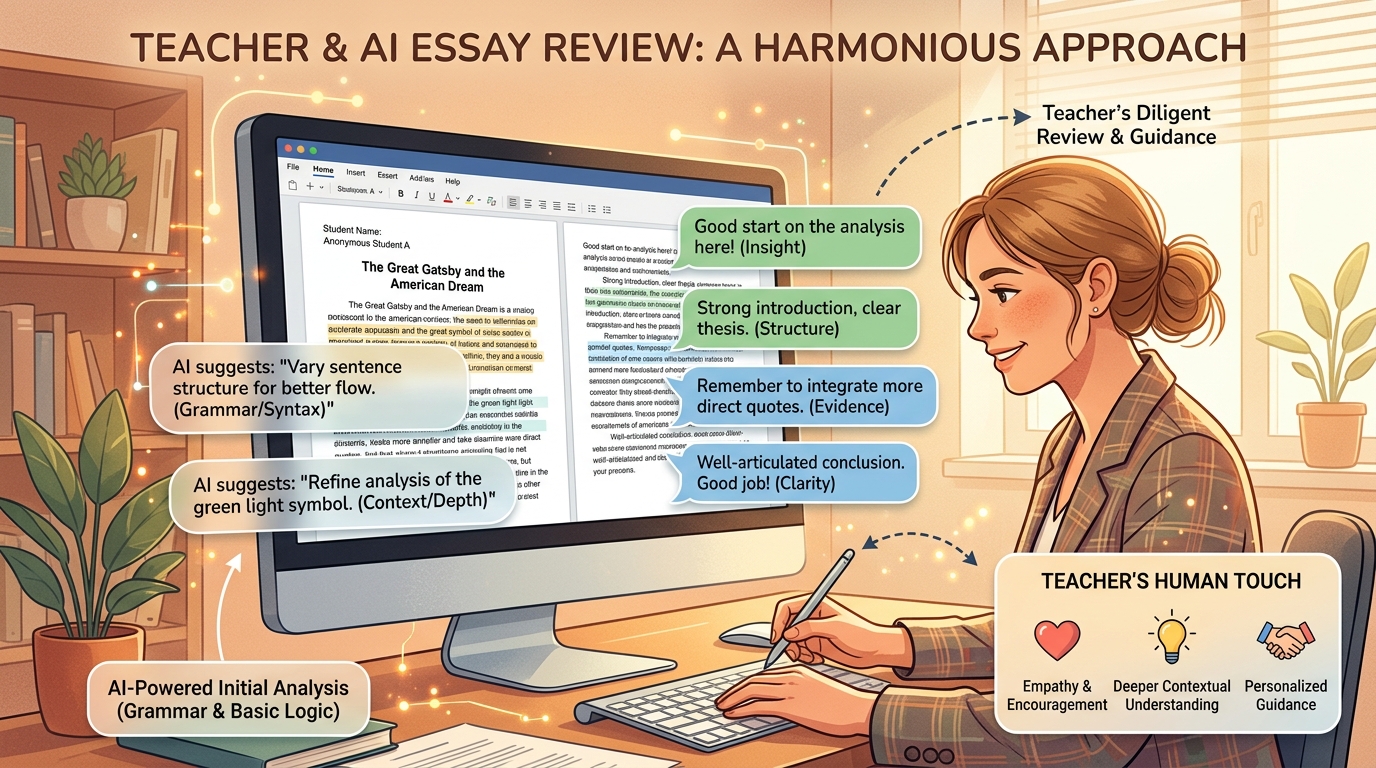
Applying the 4 D Framework to Grading
- Delegation: We ask Claude to analyze student responses against the rubric and draft a formative feedback note highlighting strengths and growth areas.
- Delineation: We input the prompt, the evaluation rubric, and the student’s text (anonymized). We request an encouraging, empathetic tone.
- Discernment: Critical Step. The teacher reads Claude’s feedback. Did Claude understand the student’s intent? Did it misinterpret creative phrasing as an error? The teacher edits and refines the text.
- Diligence (Golden Rule): Absolute Anonymization and Final Human Judgment. Never upload real names, IDs, or personal student data into the AI. The final quantitative grade is solely the teacher’s professional responsibility.
Mandatory Anonymization Protocol
Before pasting any student work into Claude, apply desensitization techniques:
| Original Data | Replacement for Claude |
|---|---|
| Student John Smith | Student A |
| Central High School | High School X |
| Peer references | Peer 1 / Peer 2 |
Practical Prompt Example for Formative Feedback
Act as an empathetic yet rigorous teacher mentor. I will provide an assessment prompt, evaluation rubric, and a student response (referred to as Student A).

Prompt: [Briefly insert the assignment prompt]
Rubric: [Insert main criteria]

Student A's Response:
"""
[Paste anonymized student text here]
"""

Please generate:
1. A 3-paragraph qualitative evaluation using this structure:
   - Paragraph 1: Key strengths of the work (what was done well).
   - Paragraph 2: The primary error or concept needing depth (explained simply).
   - Paragraph 3: A guiding reflection question for the student to revise and improve their work.
2. Suggested score according to the rubric (as a draft for teacher review).

Maintain a warm, encouraging, and pedagogical tone.
Summary Table: Do’s and Don’ts with Claude in Education
| Dimension | DO’S (Best Practices) | DON’TS (Risks & Anti-Patterns) |
|---|---|---|
| 1. Delegation | Use Claude to overcome “blank page syndrome”, diversify activities, and summarize common student error patterns. | Delegate pedagogical bonding, classroom empathy, or final grading blindly. |
| 2. Delineation | Provide detailed context, role, student academic level, format constraints, and examples. | Give vague one-liner prompts like “make a 9th grade history test for me”. |
| 3. Discernment | Read and audit every response; verify dates, formulas, and historical facts; adjust tone for your class. | Assume Claude’s output is 100% accurate and hand it out without reviewing. |
| 4. Diligence | Anonymize all student text, verify alignment with official curriculum, and sign off as the teacher. | Upload real student names or confidential student information to the platform. |
Conclusion: The Teacher as Learning Architect
Claude is not here to replace high school teachers; it is here to liberate them from bureaucratic and repetitive tasks so they can engage in what no AI will ever do: look a student in the eye, understand their emotions, inspire curiosity, and mentor their human growth.
By applying the 4 D framework (Delegation, Delineation, Discernment, and Diligence), teachers transition from passive observers of technological change into empowered pedagogical architects: capable of tailoring learning materials for every student and delivering deep feedback that drives genuine understanding.