 Facundo Uferer
When a program starts to grow, writing everything inside main becomes a bad idea.
Yes, it can work for minimal examples. But when the problem grows, you need to divide the program into smaller, understandable, and reusable parts.
That’s where modularization comes in.
In this lesson you’ll learn:
- what modularization is
- what a subprogram is
- what the conceptual difference between function and procedure is
- how to declare and use a function in C
- why modularization improves program design
Key idea: modularization is dividing a large problem into smaller parts so you can think about it, implement it, and maintain it better.
What is modularization?
Modularization means dividing a program into smaller, organized parts, where each one fulfills a specific task.
Instead of having a huge block of code mixing everything together, you separate responsibilities.
For example, instead of writing a giant program that:
- reads data
- validates data
- calculates results
- displays results
mixing everything into a single block, you can separate each task into a different part.
Why modularize?
Because it improves many things at once:
- the code is easier to understand
- each part has a clearer responsibility
- you can reuse logic
- it’s easier to detect errors
- the program grows more orderly
What is a subprogram?
A subprogram is a part of the program that performs a specific task.
It’s basically a named block of code that the program can call when it needs to execute that task.
In C, subprograms are expressed through functions.
Functions and procedures: conceptual difference
Here’s a VERY useful distinction at a pedagogical level.
Function
A function is a subprogram that returns a result.
For example, a function that adds two numbers and returns the total.
Procedure
A procedure is a subprogram whose main idea is to perform an action, without focusing on returning a value.
For example, displaying a message on the screen.
Important in C
In C, technically everything is expressed with functions.
In other words: even what we conceptually call a “procedure” is usually written as a function with void return type.
So, the difference between function and procedure in this course is taught as a conceptual distinction, not as two different language mechanisms.
Example of a function that returns a value
int sumar(int a, int b) {
    return a + b;
}
This function receives two integers and returns another integer.
Example of a conceptual procedure in C
void mostrarSaludo() {
    printf("Hello\n");
}
Here no useful value is returned. The function performs an action.
General structure of a function
tipo_retorno nombre(parametros) {
    instrucciones;
}
Parts
- return type: what the function returns
- name: how it’s called
- parameters: data it receives
- body: instructions it executes
Complete example
#include <stdio.h>

int sumar(int a, int b) {
    return a + b;
}

void mostrarResultado(int resultado) {
    printf("The result is %d\n", resultado);
}

int main() {
    int total;

    total = sumar(5, 3);
    mostrarResultado(total);

    return 0;
}
What do you gain from this?
A lot.
Because now the logic is separated:
- one part adds
- another part displays
maincoordinates
That makes the program much easier to read.
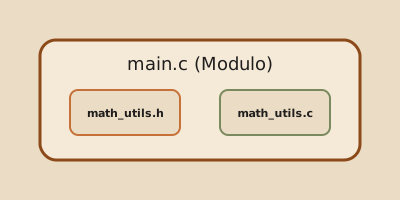
Modularization across multiple files
When the program grows further, modularization can also be reflected in separate files.
Generally speaking, these appear:
.hfiles for declarations.cfiles for implementations- a
main.cas the entry point
Conceptual example
Header file
int sumar(int a, int b);Implementation file
int sumar(int a, int b) {
    return a + b;
}
When should you create a subprogram?
It’s convenient when:
- a task makes sense on its own
- a piece of logic is repeated
- a block inside
mainis already growing too large - you want to separate responsibilities
Common mistakes when starting
1. Putting everything in main
That makes the code hard to read and maintain.
2. Creating functions without a clear responsibility
It’s not about dividing for the sake of dividing. Each subprogram must have a concrete intention.
3. Not distinguishing between “calculating” and “displaying”
Good modularization separates calculation, input, and output when it makes sense.
Summary
- modularization is dividing a program into smaller parts
- a subprogram performs a specific task
- a function returns a value
- a procedure, conceptually, performs an action
- in C, both are represented by functions
- modularization improves clarity, reusability, and maintainability
Final thought
Modularization is a sign of maturity in programming.
When you stop thinking of the program as a giant block and start thinking of it as pieces with clear responsibilities, your design improves GREATLY.