 Facundo Uferer
Once you start working with functions, a central question appears:
what data does each function know and how is that data passed to it?
That’s where local variables, global variables, and parameter passing come into play.
In this lesson you’ll learn:
- what local and global variables are
- what formal and actual parameters are
- what pass-by-value is
- what pass-by-reference is
- how data changes inside and outside a function
Local variables
A local variable is a variable declared inside a function.
It only exists within that function and can only be used directly there.
Example
void saludar() {
    int veces = 1;
    printf("Hello %d\n", veces);
}
The variable veces is local to saludar.
Global variables
A global variable is declared outside all functions.
It can be used by multiple functions in the program.
Example
int contador = 0;

void aumentar() {
    contador = contador + 1;
}
Conceptual difference
- the local variable belongs to a function
- the global variable belongs to the entire program or a much wider scope
Should you use global variables?
They can be useful in some cases, but they must be used wisely.
Why? Because if many functions modify the same global variable, the program can become harder to understand and control.
For beginners, a good rule is this:
prefer local variables unless there’s a clear reason to share the data.
What is a parameter?
A parameter is a piece of data that a function receives to do its work.
Example
int sumar(int a, int b) {
    return a + b;
}
Here, a and b are the function’s parameters.
Formal and actual parameters
This distinction is very important.
Formal parameters
These are the names that appear in the function definition.
int sumar(int a, int b)Here, a and b are formal parameters.
Actual parameters
These are the real values or variables passed when the function is called.
resultado = sumar(5, 3);Here, 5 and 3 are actual parameters.
Pass-by-value
In pass-by-value, the function receives a copy of the data.
That means if the function modifies that parameter, the original does not change.
Example
#include <stdio.h>

void cambiar(int x) {
    x = 100;
}

int main() {
    int numero = 5;
    cambiar(numero);
    printf("%d\n", numero);
    return 0;
}
The displayed value will still be 5.
And why? Because cambiar received a copy of numero, not the original.
Pass-by-reference
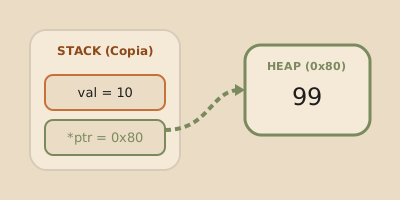
In C, there is no native “pass-by-reference” like in other languages, but the same practical effect can be achieved using pointers.
This is important to say correctly to avoid teaching it wrong.
When introductory courses talk about “pass-by-reference” in C, they’re usually talking about passing the address of a variable through pointers, so the function can modify the original data.
Conceptual example
void cambiar(int *x) {
    *x = 100;
}
And the call:
cambiar(&numero);What changes here?
Now the function doesn’t work on a simple copy of the value, but on the address of the original data.
That allows modifying the actual variable.
Complete example
#include <stdio.h>

void cambiar(int *x) {
    *x = 100;
}

int main() {
    int numero = 5;
    cambiar(&numero);
    printf("%d\n", numero);
    return 0;
}
Now the displayed value will be 100.
Comparison between both passing methods
By value
- the function receives a copy
- the original does not change
By reference simulated with pointers
- the function works on the address of the data
- the original can change
When to use each one
Pass-by-value
Use it when you only want to use the data to calculate or query something.
Pass-by-reference with pointers
Use it when you want the function to be able to modify the original data.
Common mistakes when starting
1. Believing that changing a parameter by value modifies the original
No. If it was passed by value, what gets modified is the copy.
2. Using too many global variables
That makes it harder to understand where data comes from and who modifies it.
3. Confusing formal and actual parameters
One belongs to the function definition. The other belongs to the function call.
Summary
- a local variable lives inside a function
- a global variable has a wider scope
- formal parameters appear in the definition
- actual parameters appear in the invocation
- by value, a copy is passed
- in C, the effect of pass-by-reference is achieved using pointers
Final thought
Understanding scope and parameter passing completely changes the way you read functions.
Because from now on, it’s not just about what a function does, but also what data it works with and what data it might modify.