 Facundo Uferer
Variables, Data Types, and Operators
In Java, every data value has a clearly defined type. Java is a statically typed language, meaning that every variable’s type must be explicitly declared and cannot change during execution.
1. Variable and Constant Declaration
A variable is a reserved memory space for storing information.
// Declaration and initialization
int age = 25;
double price = 99.99;
boolean isStudent = true;
char initial = 'F';

// Constant (value cannot be changed after assignment)
final double PI = 3.14159;
2. Scope, visibility, and lifetime
Scope is the region of code where a name can be used. Visibility answers from which lines that name is accessible; lifetime states how long its value exists during execution. These concepts are related but not identical.
Java uses lexical scopes defined by classes, methods, and { } blocks. There are no free global variables in Java: every value declared outside a method belongs to a class or to an instance of that class.
| Category | Declaration | Visibility | Lifetime | Initialization |
|---|---|---|---|---|
| Local variable | Inside a method | From its declaration to the end of its block | During that invocation and block | Has no default value; definite assignment is required. |
| Block-scope variable | Inside an if, for, while, or explicit block | Only inside that block | Until the block ends | Same rule as any local variable. |
| Parameter | In a method or constructor signature | Throughout that method body | During the invocation | Receives the argument value. |
| Instance field | In the class, without static | According to its access modifier | While the object remains reachable | Receives a default value if not assigned. |
| Class field | In the class, with static | According to its access modifier | From class loading onward | Receives a default value if not assigned. |
Numeric fields receive 0, booleans receive false, and references receive null. This does not mean those values are valid for the domain: a constructor should explicitly establish required state.
Complete example and shadowing
public final class Account {
    private static int accountCount = 0; // Class field
    private int balance;                 // Instance field

    public Account(int balance) {        // Parameter
        if (balance < 0) {
            System.out.println("Invalid balance, used 0 by default.");
            balance = 0;
        }
        this.balance = balance;          // this.balance selects the field
        accountCount++;
    }

    public void credit(int amount) {
        if (amount <= 0) {
            System.out.println("Invalid amount, nothing was credited.");
            return;
        }
        int previousBalance = balance;   // Local variable
        balance += amount;

        if (balance < previousBalance) {
            System.out.println("Overflow detected, the operation was discarded.");
            balance = previousBalance;
        }
    }
}
The balance parameter shadows the field with the same name. this.balance explicitly selects the instance field. Shadowing is legal, but overusing it makes it harder to see which value changes.
A block also limits names:
if (age >= 18) {
    String message = "Access granted";
    System.out.println(message);
}
// System.out.println(message); // Does not compile: message is not visible here.
Initialization rules and clear failures
Java applies definite assignment to locals: the compiler must prove that they received a value before they are read.
int result;
// System.out.println(result); // Does not compile: it may be uninitialized.

int safeResult = 0; // Correct only when 0 is a valid domain value.
Do not add an arbitrary default merely to silence the compiler without saying so. If required data is missing, validate it explicitly: print a notice and use a documented default value, as the Account constructor does. For optional data, choose and document a genuinely neutral value.
3. Primitive Types vs. Reference Types
Java categorizes data types into two main groups:
Primitive Types (Store direct values)
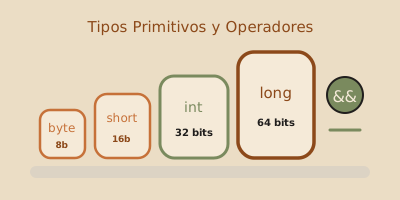
| Type | Size | Range / Example |
|---|---|---|
byte | 8 bits | -128 to 127 |
short | 16 bits | -32,768 to 32,767 |
int | 32 bits | -2,147,483,648 to 2,147,483,647 |
long | 64 bits | Large integers (e.g., 10000000000L) |
float | 32 bits | Single-precision floating point (e.g., 3.14f) |
double | 64 bits | Double-precision floating point (e.g., 3.14159265) |
boolean | 1 bit | true or false |
char | 16 bits | Single Unicode character (e.g., 'A') |
Reference Types (Store memory addresses to objects)
Examples: String, Arrays, and any custom class.
String name = "Facundo"; // Reference to a String object4. Type Casting
- Implicit Casting (Widening): Smaller type to larger type (automatic).
int intValue = 10; double doubleValue = intValue; // 10.0 - Explicit Casting (Narrowing): Larger type to smaller type (requires
(type)syntax).double exactPrice = 45.89; int roundedPrice = (int) exactPrice; // 45 (loses fractional part)
5. Java Operators
Arithmetic Operators
+, -, *, /, % (modulus / remainder).
int a = 10;
int b = 3;
int quotient = a / b; // 3
int remainder = a % b; // 1
Relational and Logical Operators
- Relational:
==,!=,>,<,>=,<= - Logical:
&&(AND),||(OR),!(NOT)
boolean isAdult = age >= 18;
boolean canAccess = isAdult && isStudent;
6. Hands-on Exercise
Write a program that declares the grades for three exams of a student, calculates their average using floating-point numbers (double), and prints whether the student passed (average >= 6.0) using a boolean expression.